A bomb attack on St. Elias Church in Damascus not only left a crater in the concrete floor, but also a gaping hole in the community. Yet it is precisely in that devastated place that a faith takes root—a faith that endures even when everything else is crumbling. “Even though we are afraid, we we’ll keep going to church.”
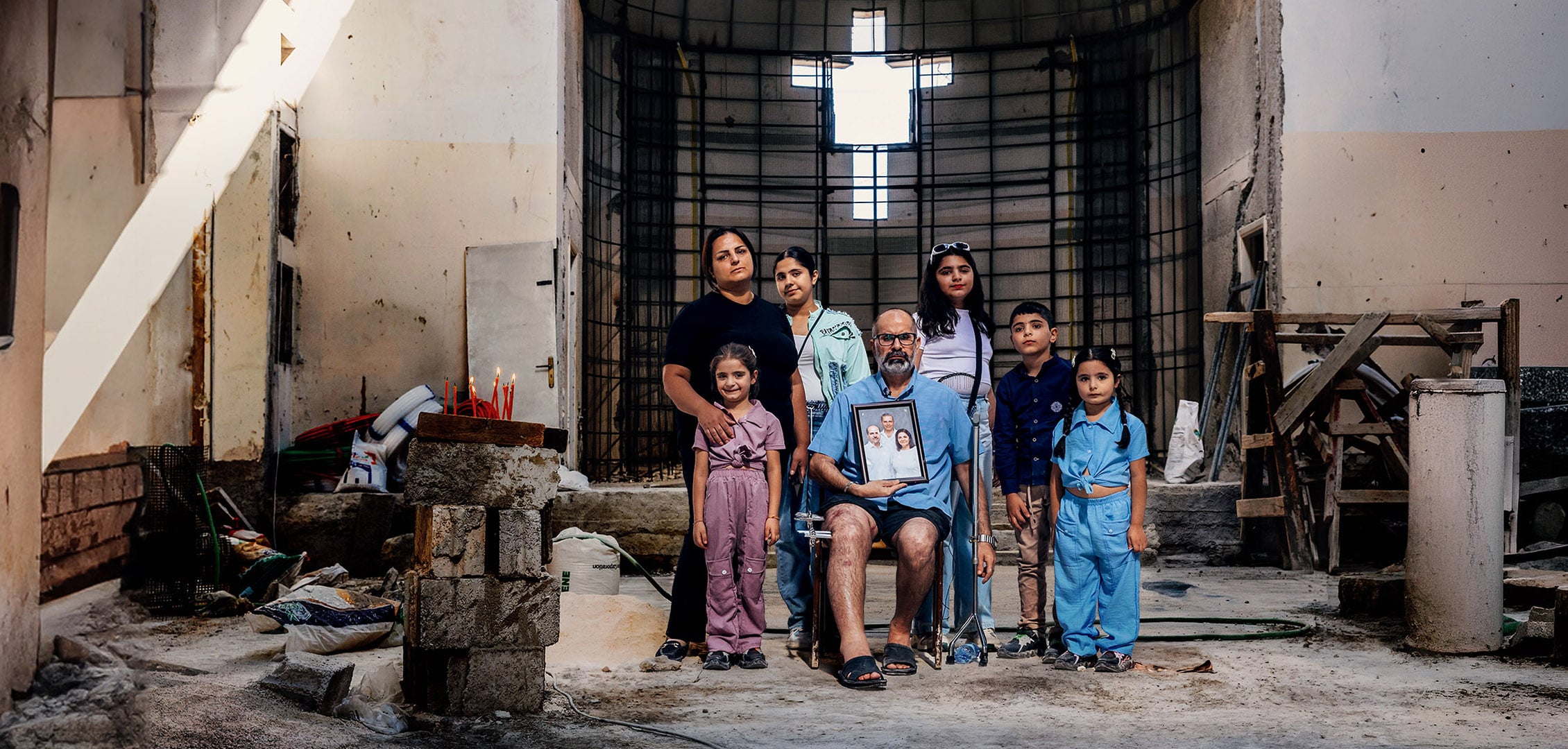
The pain on Elias’s (56) face was unmistakable when he hesitantly stepped onto the threshold of St. Elias Church. He hadn’t been back to ‘his’ church since Sunday, June 22, the day a bloody attack claimed the lives of 22 worshippers. Once inside, he stared at the spot where a suicide bomber blew himself up. The force of the explosion had blown a hole in the concrete floor.
“We believe that we live for the Lord, and we die for the Lord. Either way, we belong to the Lord.”
It is also where two of Elias’s brothers were killed while attempting to subdue the terrorist. Elias lost seven family members, a neighbour and a close friend in the attack. He was seriously injured himself. With the help of a crutch, he limped through the church hall. Metal pins protruding from his leg served as silent reminders of the attack.
Afraid of a loud noise
On a makeshift altar of stacked stones, Elias and his wife Hanan (39) lighted seven candles. The tiny flames bore witness to a faith that had not been extinguished by the explosion. At first, their five children were afraid to enter the church, but they followed soon after. That is until their youngest son, Ibrahim, heard cars honking on the street. Panic seized him, and he fled with his sisters. Loud noises still trigger traumatic memories.
Massacre
“We’ve lived through 14 years of civil war,” said Elias a little later, in the apartment where he lives with his family. “But violence like that inside a church is unheard of. It was a massacre.” That evening, around 300 people had gathered at the church to commemorate the death of Elias’s aunt, who had passed away a week earlier. “I saw Ibrahim walking with a candle,” said Hanan, showing a video on her phone taken a few minutes before the attack.
“The sound of gunfire got closer and closer,” Elias recalled. “Then the door was kicked open and someone came running in. He started shooting wildly.” Hanan crouched between two church pews. Elias heard his brother Geryes shouting for everyone to duck. Soon afterwards, there was the sound of a massive explosion.
Flat on the ground
Then everything went quiet. Geryes’s voice fell silent. It transpired that he, Boutros (another of Elias’s brothers) and a churchgoer had thrown themselves at the suicide bomber. They forced him to the ground, and a struggle ensued. During the struggle, the attacker still managed to detonate his backpack full of explosives. The three men who had tried to subdue him were killed instantly.
By their actions, the three men saved the lives of many churchgoers. The suicide bomber’s backpack was filled not only with explosives but also with screws. These would have flown everywhere after the explosion and caused a great deal of damage. However, because the men pinned the attacker to the ground, the brunt of the explosion was directed downwards into the ground. “If they hadn’t acted the way they did, there would have been many more victims,” said Elias.
“Lord, just one more child.”
Amid the chaos, Elias ran to his son, Ibrahim. Only when he reached him did he realise that he himself had two shards lodged in his thigh, one of which had pierced his artery. “The entire church was destroyed,” says Hanan, who at the time had no idea where her husband and children were. She quickly found two of her daughters, but then panic set in. “I started screaming and praying: ‘Lord, please, let me find just one more child, at least one more.’” Eventually, Hanan found all her children, but at first she didn’t recognise her daughter Sarah (12). The girl had suffered severe facial injuries. She underwent surgeries in both Syria and Lebanon.
Encouragement
After the attack, Elias and Hanan are struggling with the question of whether Syria is still the place where they want to raise their children. “If it is God’s will, then we will stay. May His will be done.” It wasn’t the first time he and his family had faced violence. Two years earlier, Hanan’s father had been shot dead. “There is always fear. Every day we are afraid that someone will come to kill us.”
““If it is God’s will, then we will stay. May His will be done.”
Nevertheless, Elias emphasised that the attack in June did not stop the church congregation from gathering. Although they were forced to meet at a different location, their faith in Christ remains steadfast. “We are firmly grounded in our faith,” he says. “Jesus says, ‘On this rock I will build My church.’ Our faith is built on the Rock, not on soap bubbles that can burst.”
Trauma counseling
To help the children regain a sense of stability, they are receiving trauma counselling. Help is also available for adult churchgoers who survived the attack. A local partner of Open Doors had already been providing trauma counselling long before the bombing of the church in Elias took place. This meant that counselling could begin shortly after the attack. For example, the children participate in creative activities, while discussion groups are available for adults.
“We combine a psychological approach with spiritual healing to address trauma in a holistic way,” says psychologist Raneen*, who is involved in this work. “This ensures that participants experience healing not only on a mental and emotional level, but also in their spiritual lives. Even in the darkest moments, God can bring healing and growth.”
Signs of hope
Elias and Hanan also see signs of recovery in their church. Recently, 22 children were baptised—the same number as the Christians who were killed in the attack. “Even though we’re afraid, we’ll keep going to church,” says Hanan. Elias adds, “We believe that we live for the Lord, and we die for the Lord. Either way, we belong to the Lord.”
Syria ranks 6th on the World Watch List.
Please pray with us
- Elias lost seven family members in the bombing. He himself was injured. Please pray for comfort during this time of mourning, and for encouragement and protection.
- Elias’s wife, Hanan, asks, “Will you pray that our children may grow up safely and without fear? Our lives should be filled with beauty, not fear.”
- Many Christians are concerned about the increasing radicalisation of Islam in parts of Syria. Pray that God will bring those at risk of radicalisation closer to Him.
- Many Christians say, “If I get the chance, I’ll leave Syria,” Pray for the Christians who are still in Syria and are serving God there by being the light and salt of their community.
(* Pseudonym)